1. Introductory Note
The Roman Pantheon, built in the Campus Martius with a final phase of construction between 118 and 125 AD, was both a work identified with the emperor Hadrian, and essentially the fourth Temple of Apollo - Sun God in Rome. Furthermore, it was the first Planetarium to have ever been created, constituting a milestone monument in the History of Culture and Architecture, as it was the first 'Catholicon of Deities' under the supervision of the 'Supreme Deity' of the Hellenistic era and the Late Antiquity. With its dynamic geometric structure and sculptural décor, it summarized in a three-dimensional space all the religious and astronomical knowledge of the time about the Cosmic system "Heaven / Sun and Earth", or, in other words, the knowledge about the Zodiac cycle and the relative positions of the Sun, the Moon, the Earth and the five known planets - deities within it.
The monumental design and the conceptual structure of the Pantheon were based on the astonishing knowledge of its brilliant architect (who was given an absolutely absurd damnatio memoriae), on the great personality and advanced interests of the philhellene emperor Hadrian, but also on the arithmetic-geometric and philosophical views of the Pythagorean mathematicians active until that early era: Menelaus of Alexandria (c.70-140 AD), Theon of Smyrna (c.70-140 AD) and Nicomachus of Gerasa (c.60-120 AD). As we will show, their theories, if not themselves, certainly participated in the monument’s design, under the guidance of the experienced architect who must have had access to their knowledge. It is something that gives some idea of the principles and the people who prepared his study, and, in addition, it also determines its dating.
By building the Pantheon, Hadrian, who maliciously expunged the name of the architect he himself appointed, won alone the intellectual ‘IMMORTALITY’ so desired by every mortal man…
From a philosophical point of view, the SPHERE, mentally inscribed in the CYLINDRICAL Rotunda, represented the Platonic form of the Universe, the so-called ‘Cosmic sphere’, which included and recreated all the individual elemental entities – Cosmic forms.
At the same time, the surrounding cylinder created the boundary that marked the 8th outer Celestial ring, the Universal boundary of the Ecliptic, i.e. the Platonic 'anima mundi'
within which the Planets move, while on its outer surface is dominated by the Zodiac constellations.
According to the perception of the time, the foundation of the Cosmic system was the Earth. Its overall structure included the four entities – rhizomes organized into Tetraktyes, since according to Pythagoras everything in the Universe is reduced to NUMBERS. The entire system could be considered as inscribed in an imaginary CUBE, a perfect solid body whose side was equal to the diameter of the sphere
| [8] | Joost – Gaugier C. L, “Measuring Heaven: Pythagoras and His Influence on Thought and Art in Antiquity & Middle Ages”, Cornell University Press, 2006. |
[8]
.
The Dome of the Pantheon, enriched with five rows of embossed coffers, as well as the other structural elements of its Rotunda, were designed with the same logic as the ancient Greek Tholos of Epidaurus. It was a well-known monument in the Roman world, and was considered groundbreaking both as a specialized temple and as an advanced architectural form. However, with a certain reversal: The peculiar Heliocentrism which was prescribed by the design of its floor together with the inner Peristyle of the Tholos cella, was depicted again in the Pantheon with the detailed design of its floor, under the triumphal "Heavenly Dome" of its Rotunda according to the commentary of Cassius Dio
. This extremely important reversal lies in the fact that the domed interior space of the Roman temple became, for the first time in history, dominant, introverted and utilitarian, constituting in some manner the model that ALL Christian temples have followed since then.
Furthermore, the structure of this particular building NOT only marked a turning point in construction techniques, but also incorporated a new conceptual identity, a new interpretation of the "Culture of Light" through its modern geometric form, initiating under the best possible conditions a first historical process of changing Visual or/and Expressive Patterns in Architecture and Art. In other words, it became the inaugural monument – milestone of the historically first “Romantic” transformation of the hitherto “Classical” architectural practice, the relationship between which is clearly indicated by the classical-style Propylaea of the temple, which typologically connects the previous style with the new romantic idiom.
Introductory Note II
As a further explanatory introduction to the main text that follows, we present a very interesting geometric arrangement, which highlights the mechanism of the construction of four geometric tools that we conventionally call the Quadrangular
| [23] | Vilouras Dimitrios, “Egypt in the shadow of the Followers of Horus II – An archaeological insection of the concept of "Solar pillars"(Part IV). The cult image of an 'Eight-pointed star' and the derivative design-aids in both Ancient Mesopotamian and the Ancient Egyptian Architecture”, published in 01-20-2023(a) https://independent.academia.edu/DVilouras |
| [24] | Vilouras Dimitrios, "Acropolis of Athens, PARTHENON: The realization of the absolute in the context of an Enlightened Ancient Greek Architecture. The exemplar design method of Iktinus", published in 03-23-2023(b)
https://www.academia.edu/98977953/Acropolis_of_Athens_PARTHENON |
[23, 24]
, Triangular, Pentagonal and Heptagonal geometric sequence. These renowned structures, from which the Quadrangular sequence has a documented origin in Ancient Egypt of ~2650 BC, have historically been the permanent design infrastructure upon which was created 100% of the Architectural culture of the Pagan + Christian European continent, as well as the Islamic Middle East, at least until the 18th century of the modern era.
Specifically, for the construction of a heptagon inscribed in a circle (and consequently of a tetrakaidecagon, or, and a twenty-octagonal), it should be noted that its side is equal to 1/2 of the base of an equilateral triangle inscribed in the same circle.
After the collapse of the Mycenaean civilization in the Late Bronze Age and within the context of a reorganized Doric Greece, prominent personalities saw the Light. According to converging and already overlapping information, among these men who strived for knowledge was Pythagoras of Samos (c. 570-500/495 BC), a leading personality of the time. What is known of the Pythagorean School in Magna Grecia – Southern Italy is, substantially, from a book written by the Pythagorean Philolaus of Croton or Tarentum (born c.475 BC). This work was followed by a long series of "doxographies" related in general to Pythagorean philosophy, covering a very long period of at least 25 centuries!!! Among other information were also the aforementioned geometric arrangements, which were transmitted during the second half of the 1st millennium BC closely associated with the name and activities of Pythagoras.
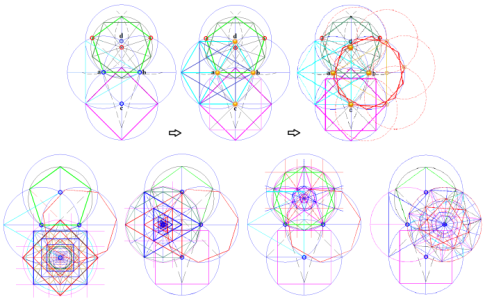
Figure 1. The striking construction of an Equilateral triangle, a Square, a Pentagon, a Heptagon and their mirror images. It is attributed to Pythagoras and is practicable through the geometry of the ‘Four self-intersecting circles of equal radius’, where the circumference of each one passes through the centers of the nearer others.
Between reality and myth, Pythagoras' wanderings and the history of his life are more or less known. The most important thing for such a prominent sage, who has never ceased to remain relevant on a mathematical-philosophical level until modern times, is that he is rightly or wrongly attributed with a multitude of teachings in areas such as: Way of Life, Dietary, Musical harmony Ratios, Ethics, Metaphysics, Theology etc, but also in the field of Mathematical innovations such as: Theory of proportions, Classifications and Theory of numbers – 'Primes', 'Even and Odd' numbers, ‘Perfect’, 'Amicable' and 'Figurate' (triangular, polygonal, tetrahedral, pyramidal…) numbers, 'rational' and 'irrational' numbers, and so on
| [2] | Caiazzo Irène et al. (edrs), 'Brill’s Companion to the Reception of Pythagoras and Pythagoreanism in the Middle Ages and the Renaissance', Brill, Leiden, Boston, 2022. Review by Theofanis Tsiampokalos: https://brill.com/edcollbook/title/38721 |
| [18] | Renger A.-B., Stavru A. (edrs), "Pythagorean Knowledge from the Ancient to the Modern World: Askesis, Religion, Science", Harrassowitch Verlag, Wiesbaden 2016. |
[2, 18]
.
The dictum of the Pythagorean School was that “everything is numbers” and “the number ten, that of the Universe, is what recommends the tetraktys”. In order to interpret laws of Nature and Heaven, Pythagoras updated some mathematical terms of Ancient Egyptian origin, and philosophical speculations related to the image of the Universe and the Supreme Deity (as was recorded without any "nominal" reference (?) by newer Greek philosophers, or even, was speculated by almost all of his later scholars), and in that milieu he specialized the concept of the sacred Tetraktys, an original system of place – ideological value of the numbers from 1 (a΄) to 10 (i΄) organized sophistically in the body of an equilateral triangle. In their metaphysical negotiation, Pythagoras had also attached the accompanying theory of the "four entities - rhizomes"
which (according to Plato) constituted the basic structural elements of the Cosmos, while, according to Iamblichus’ description, corresponded as follows: fire το the monad (1) – i.e. to One, Apollo, the principle of all things – air to the dyad (2), water to the triad (3) and earth to the foursome (4). What subsequently emerged as a result of the labyrinthine Pythagorean "Theology of Numbers" had to do with the ideological basis described by Philolaus, according to which "numbers are the beginning of everything within an objective World which, with the union of the divergents and the concord of the discordants, progresses reflecting a state of Harmony and Order". Despite the fact that numbers had been considered the ideological derivatives of verifiable arithmetic-geometric operations, and therefore arbitrary on a logical basis as Aristotle (c.384-322 BC) pointed out early on, they exerted a fascination from which, apart from the numerous disciples of Pythagoras, not even the related to the subject thinkers of the following millennia up to our time did not escape, with the first and most prominent among them being the Athenian Plato (428/27-348/47 BC).
Systematically following a “quadruple pattern”, the greatest and most influential Pythagorean contribution seems to be ultimately located in the field of Geometry, as the generally brilliant numerical relationships he elaborated have probably emerged from this sector. It is no coincidence that the de facto inclusion of Platoin the Pythagorean field of knowledge
| [5] | Diogenes Laertius, "Lives of Eminent Philosophers"
https://topostext.org/work/221 |
| [7] | Heath Th., “A History of Greek Mathematics”, Vol.I, Dover Publications, Inc., N. York, 1981. |
| [8] | Joost – Gaugier C. L, “Measuring Heaven: Pythagoras and His Influence on Thought and Art in Antiquity & Middle Ages”, Cornell University Press, 2006. |
| [19] | Russell Bertrand, "A History of Western Philosophy", Simon and Schuster Touchstone Books, New York, 1945. Review of G. Donald Allen in the paper "Pythagoras and the Pythagoreans", 1999. |
[5, 7, 8, 19]
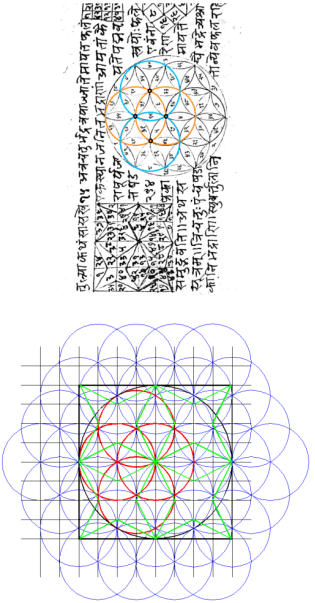
is an assumption that, in addition to the writings of this equally great thinker, is also supported by his own dictum "μηδείς αγεωμέτρητος εισίτω / no one without Geometric knowledge". The 'honorary' attribution to Pythagoras of the well-known (from distant Mesopotamian and Egyptian antiquity) "Theorem of the sides of a Right Triangle", directly related to the so-called "Pythagorean Triads", was, we assume, a tribute, which came to "reward" his enormous contribution to Ancient Greek, Hellenistic, Roman, European Medieval and Renaissance culture, after the establishment of the "Geometry of the Four self-intersecting circles". It is an astonishing but equally simple construction, which for some "asymmetrical" and "unscientific" reasons remained in historical and mathematical obscurity, divided "according to Euclidean tactics" into many individual geometric 'requests'...
Bibliographically and, of course, descriptively, Late Antiquity and its cultural expansion into the European Middle Ages and the Renaissance seem to ignore the subject! The recording, however, of the "Geometry of the Four self-intersecting circles" in manuscripts of the Indian subcontinent is a reality, and it occurred at a time when it is found to have been fraudulently omitted both from Euclid's compendium entitled "Elements" and from all subsequent European mathematical treatises...
Narayana’s arithmetic treatise, the “Moonlight of mathematics”, states in its final verse that it was completed on a date corresponding to 1356. Must be noted that on the re-design process of the "Geometry of the four self-intersecting circles" by Narayana a square grid emerges, on which the author establishes a second division of its individual sectors and calls the parts of the new arrangement "magic squares". On their basis, he then applies some sophisticated arithmetic calculations...
Narayana seems to have been one of the first authors to introduce magic squares as a topic in Indian arithmetic, although they were certainly known in India since at least the 6
thcentury AD.
| [9] | Kusuba Takanori, "Combinatorics and Magic Squares in India: A Study of Narayana Pandita’s “Ganitakaumudı” (Ch.13-14) Ph.D. diss., Brown University, Providence, RI, 1993. |
[9]
It may be that the exposure of the Islamic magic squares, which date back to the 9th century AD,
| [20] | Sesiano J., "Quadratus Mirabilis", p.199-233. In J.P. Hogendijk, A. L. Sabra (eds), "The Enterprise of Science in Islam", The MA/London: MIT Press, 2003. |
[20]
captivated later Indian mathematicians’ interest in exploring the theory behind them. Their historical recording shows that they were known throughout the Middle Ages, both in Islam(and therefore in Christianity too), as well as in Indian subcontinent.
The absolutely remarkable fact is that the geometric constructions of "a Square, an Equilateral Triangle, a Pentagon, a Heptagon and their mirror images" – conventionally called "Quadrangular, Triangular, Pentagonal and Heptagonal geometric sequences" – are simultaneously accessible by means of a simple and unified geometric arrangement of "four self-intersecting circles", and the sole use of ruler and compass. It is also certain that even before the time of Pythagoras, at least some of them (such as the Quadrangular sequence), were already individually accessible and with significant architectural applications during the development of their qualities.
This pivotal position, as formulated herein, is supported by the fact that the specific arrangement of the “Four self-intersecting circles” was considered an extremely sacred form, and held a central position within the framework of Platonic (Timaeus) and therefore Pythagorean Dogmatics.
| [23] | Vilouras Dimitrios, “Egypt in the shadow of the Followers of Horus II – An archaeological insection of the concept of "Solar pillars"(Part IV). The cult image of an 'Eight-pointed star' and the derivative design-aids in both Ancient Mesopotamian and the Ancient Egyptian Architecture”, published in 01-20-2023(a) https://independent.academia.edu/DVilouras |
| [27] | Wikisource: Plato’s ‘Timaeus’ - Original text in ancient Greek [36c, 53c - 56c]. https://el.wikisource.org/wiki/%CΤίμαιος (accessed January 2026). |
[23, 27]
In addition to the knowledge of the anciently established Quadrangular geometric sequence (which, as we have shown, was first used in the design and construction of the Pyramids), the Samian sage's focus on Triangular, and probably on the more recently accessible Pentagonal, perhaps even Heptagonal geometric sequences, led him to establish the "Tetraktys" as the basis of a peculiar 'Number Theory', as well as to the direct geometric construction of the "Golden Section" which have since been codified and evolved into pure mathematical knowledge.
Furthermore, the complete construction of the well-known Five Platonic Regular Polyhedra – Cosmic Forms
, attributed mainly to Plato's teacher, the Pythagorean mathematician Theaetetus (c.417-369 BC), would not have been possible if the geometric sequences that had as their source the arrangement of the "Four self-intersecting circles" had not been so well-structured.
2. Ad Quadratum Axial Traces in the Ideal Dimensioning of the Pantheon’s Groundplan: The Design of Its Floor
Useful notes:
1) Sources of the Pantheon drawings:
a)
. Dehio, Gustav von Bezold, 1887–1901 (pl. 1, source for the ground plan & section).
b)
| [12] | Lueger Otto, “Lexikon der gesamten Technik und ihrer Hilfswissenschaften”, Bd.5, Stuttgard, Leipzig, 1907. |
[12]
Otto Lueger, 1907 (s.790, 791).
c)
| [22] | Tuck S.L., “A History of Roman Art”, J. Wiley, Blackwell, 2015. |
[22]
Steven L. Tuck, 2015 (Figures in p.220).
d)
| [13] | Marder T.A., M. Wilson Jones (edrs), “From Antiquity to the Present”, Cambridge University Press, 2015. Reviewed by Rabun Taylor, AJA, Vol. 121, no. 4, 2017. |
[13]
T. Marder, M. Wilson Jones (edrs), 2015. Reviewed by Rabun Taylor, 2017 (Ch.3, pl.6: Detailed drawing of the interior of the Pantheon).
2) Registered dimensions were in Roman feet: 1 Rf = 0,297 m.
3) Suggestion to the reader: Please, make an electronic archive of the images - drawings, which thus can be enlarged and provide detailed design information.
The way in which the Pantheon was designed and dimensioned is based entirely on the ad Quadratum geometric sequence, a timeless design infrastructure whose history begins in Proto-Dynastic Egypt, and which, as a "smart" device, enabling the drawing and dimensioning of architectural plans and details both in plan and section.
It is thus:
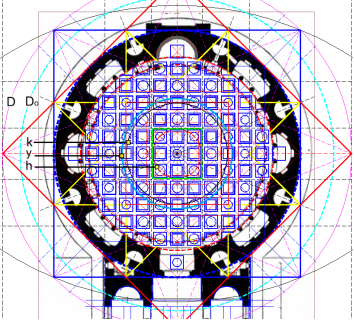
The diameter D of the perimeter circle of the "Primary ad Quadratum geometric sequence", which was preselected as a design infrastructure, was chosen to be 270 Rf (3x3x3x10).
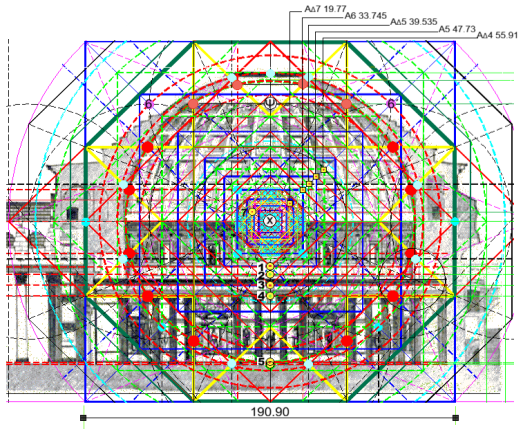
The external outline of the Rotunda is inscribed in A1, the 1st internal square (blue) of the "Primary ad Quadratum geometric sequence". The side of A1125 = 47.73 Rf. The resulting factor (a) of the sequence is equal to A1
The side ΑΔ1 of the 1st inscribed square of the "Secondary ad Quadratum geometric sequence" (dashed green) has a value equal to 4a = 4x39,54 = 158.16 Rf. Therefore, the diameter DΔ of the perimeter circle of the "Secondary geometric sequence" has a value of ΑΔ1Δ2 of its 2nd internal square has a value equal to ΑΔ1Δ3 of its 3rd internal square has also a value equal to 79.08 Rf.
Using the right triangle (1-2-3 shaded in cream, cf
Figure 4) and the emerging relationships of the elements of the design infrastructure, it follows that the sphere, and therefore (after a vertical section of it) the great circle inscribed in the interior of the Pantheon, has a diameter D2 equal to 2x√[A5/2 + (Α
Δ3 - A
5)/2)]
2 + [A
Δ3 - (Α
Δ3 - A
5)/2)]
2 = 149.50 → 150 Rf (5x3x10 or 1,5x100) or 44.50 m. In other words, a diameter with a dimension of 150 Rf was chosen to result, which presents a pure Ratio of 9/5 to the sacred product (3x3x3x10) or 270 Rf. It is known that the number 3 (a sacred number in Christianity as well) corresponds to the "basic properties of Sunlight", while the number 10 multiplied by itself gives the number 100, which is considered to depict the ‘Universal reach’ of Apollo - Helios, a property also known in Ancient Greece by the term " Hekatompedos"
.
A second circle inside the Pantheon, inscribed in the 1st internal square of the "Secondary geometric sequence" (dashed green) with side ΑΔ1, has a diameter D3 equal to the said side, i.e. 158.16 Rf.
The difference (D3 - D2)/2 = (158.16 - 150)/2 = 4.10 Rf = 1.20 m, gives the thickness of the Dome at its upper level, namely beyond the last zone of the embossed coffers.
The local diameter that corresponds to the facial opening of the semicircular (and trapezoidal) niches of the inner perimeter of Pantheon, is equal to the side A6 of the 6th internal square of the "Primary Geometric Sequence" (blue), namely is equal to A1
Based on the dimension of 33.75 Rf, the "Oculus" of the Dome (and therefore the face of the perimetrical niches of the ground floor) is chosen to have an opening with diameter equal to 30 Rf (3x10), or 8.90 m. This dimension is defined by the circle of diameter 33.75 Rf after subtracting a dimension of 3.75 Rf or 2x1.875 Rf or 2x0.55 m, which was used for the construction of the perimeter protective parapet of the Oculus. Consequently, the new ratio 150/30 of the diameter D2 to the diameter of the Oculus is now 5/1. Furthermore, the circle on the floorplan that is depicted as tangent to the rear edge of the niches, is determined graphically to have a diameter D4 equal to 150+(30x0.978) = 179.35 Rf or 53.27 m. The reduction factor of 0.978 concerns the small distance between the straight line of the diameter of the face of each niche, and the part of the circumference D2 that passes through the two ends of the above diameter.
The circle that defines the width / projection of the eight perimeter Chapels / Aediculae has a diameter D1 equal to the side A2 of the 2nd inner square of the “Primary geometric sequence”, i.e. equal to A1
The outer outline of the Rotunda of the Pantheon is inscribed in the 1st inner square of the "Primary Geometric Sequence" and therefore has a diameter D5 equal to A1 = 190.90 Rf or 56.70 m. Therefore, the thickness of the external masonry is defined as (190.90 –150)/2 = 20.45 Rf or 6.10 m. Moreover, the ratio of the diameters of the circles D5 and D2 is 190.90 / 150, equal to 14/11 or 1.2727.
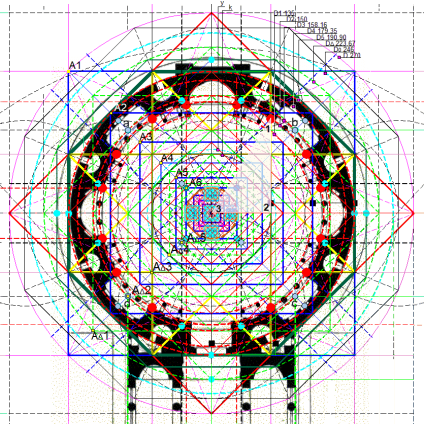
During further processing of the floor plan, one can observe that the doubling of the significant internal square which is marked as a-b-d-c and formed by the vertices of the A
Δ2 2nd internal square of the "Secondary geometric sequence" (dashed green,
Figure 3), delimits the outline of the Classical-style Propylaeum of the temple.
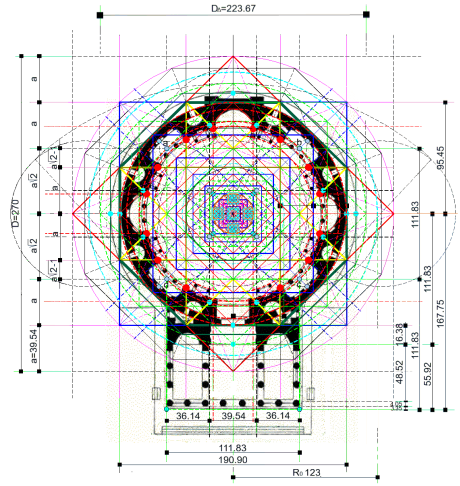
Figure 3. The application of the ad Quadratum design infrastructure to the floor plan of the Pantheon.
Figure 4. Detailed application of the ad Quadratum design infrastructure to the floor plan of the Pantheon.
The distance between the face of the two niches of the Propylaeum and the center of the ad Quadratum geometric sequence (which coincides with the center of the Pantheon) is equal to the semi-diagonal of the 1st, at a 45° angle, in-ternal square of the "Secondary geometric sequence", which has a value of √ (158,162/2) or 111.83 Rf.
Furthermore, the distance of the front face of the Propylaeum from the center of the ad Quadratum sequence is 1.50 times the side AΔ2 of the 2nd internal square of the "Secondary geometric sequence" with a value of 111.83 Rf, i.e. it is equal to 167.75 Rf or 49.82 m. Therefore, the distance between the face of the two outer niches and the front face of the Propylaeum is 167.75 - 111.83 = 55.92 Rf or 16.60 m.
From the foregoing it follows that, if the distance between the face of the niches and the main entrance of the temple is equal to (DΔ – Α1)/2 = (223.67 - 190.90)/2 or 16.38 Rf or 4.85 m., then the total depth of the Propylaeum is 55.92+16.38 = 72.30 Rf or 21.45 m.
The eight-columned classical-style Propylaeum of the monument was constructed with a total of 16 plus 4 columns, with the latter being incorporated into the ends of the two niches - chapels dedicated to the Sun and the Moon, which were designed as forerunners on the sides of the main entrance of the temple.
The Propylaeum is divided into three aisles. In the sense of width, the total distance between the outer sides - cheeks of the columns is equal to the side of AΔ2 of the 2nd internal square of the “Secondary geometric sequence” (green dashed) with a value equal to 111.83 Rf or 33.20 m, while, in the sense of depth, the distance between the outer sides - cheeks of the columns of the main face of the Propylaeum from the face of the niches - chapels is 52.57 Rf or 15.60 m.
The central aisle has a typical opening equal to the side AΔ5 of the 5th internal square of the "Secondary geometric sequence" with a value of 39.54 Rf or 11.745 m. Consequently, each one of the two side aisles have a typical opening of (111.83 – 39.54)/2 = 36.14 Rf or 10.735 m.
It is speculated that during the period of the construction study, the configuration of the Prostasis provided for columns with a base diameter of 4.05 Rf or 1.20 m. So, the intercolumniation of the main facade should have had an opening of 11.345 Rf or 3.37 m, and of the side facade an intercolumniation of 12.125 Rf or 3.60 m.
A derivative of the ad Quadratum design infrastructure is the so-called "Celestial Circle" (azure) with diameter Dο, which is involved in a process of “geometric squaring of the circle” (cf
| [23] | Vilouras Dimitrios, “Egypt in the shadow of the Followers of Horus II – An archaeological insection of the concept of "Solar pillars"(Part IV). The cult image of an 'Eight-pointed star' and the derivative design-aids in both Ancient Mesopotamian and the Ancient Egyptian Architecture”, published in 01-20-2023(a) https://independent.academia.edu/DVilouras |
[23]
D. Vilouras, “Egypt in the shadow..., p.38-41).
Its perimeter includes both the circular Temple and the two ex-ternal niches located on either side of the main entrance. Its radius Rο results from the relationship a(→3+√2)/√2. Be-cause of the factor (a), equal to 39.54 Rf, its diameter Dο takes a value almost equal to 246 Rf.
During our specialized research, it has become clear that the treatises of both Nicomachus of Gerasa and Theon of Smyrna
| [6] | D’ooge M.L., “Nicomachus of Gerasa. Introduction to Arithmetic”, Vol IX, MacMillan, New York, 1926
https://babel.hathitrust.org/cgi/pt?id=mdp.39015005675411;view=1up;seq=40 |
| [8] | Joost – Gaugier C. L, “Measuring Heaven: Pythagoras and His Influence on Thought and Art in Antiquity & Middle Ages”, Cornell University Press, 2006. |
| [21] | Theon of Smyrna, "Θέωνος Σμυρναίου “Των κατά το μαθηματικόν χρησίμων εις την του Πλάτωνος ανάγνωσιν"[Expositio rerum mathematicarum ad legendum Platonem utilium], Ελλ. Μεταφ. Αίθρα, Αθήνα, 2003. |
| [32] | Wikipedia: Nicomachus of Gerasa.
https://en.wikipedia.org/wiki/Nicomachus (accessed January 2026). |
| [33] | Wikipedia: Theon of Smyrna.
https://en.wikipedia.org/wiki/Theon_of_Smyrna(accessed January 2026). |
| [35] | Mac Tutor, University of St Andrews, Scotland, J.J. O'Connor and E.F. Robertson, 1999: Theon of Smyrna.
https://mathshistory.st-andrews.ac.uk/Biographies/Theon_of_Smyrna/ (accessed January 2026). |
[6, 8, 21, 32, 33, 35]
contributed to the conceptual and computational support of the architectural ingenuity of the era of emperor Hadrian.
Reexamining the main mathematical-philosophical theme of the Platonic structure of the Cosmos, the Neopythagorean Theon of Smyrna argued that "out of a set of eleven (11) Tetraktyes that made up the Cosmic sphere – Universe, the known four (4) elemental entities or roots (i.e. earth, water, fire and air) constituted the first tetrad. The next seven (7) followed, representative of which were the Moon, Venus, Mercury, the dominant Sun, Mars, Jupiter and Saturn", [which, for the ancient intellect, constituted a Pantheon in their entirety].
The Pythagorean-inspired design of the overall internal and external morphological structure of the Pantheon was entirely based on the applied ad Quadratum geometric sequence, which functioned here as an exclusive design infrastructure. As for the floor of the monument, this also must have been designed exactly on the basis of the same infrastructure, by incorporating the views of Theon of Smyrna, namely, his theory on a set of eleven (11) Tetraktyes which constitute the Cosmic sphere. And indeed, after a completely new schematic analysis of the Temple floor, it is revealed that it truly numbered 10+1 interlocking Tetraktyes.
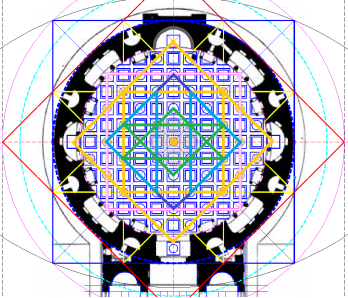
Figure 5. Design of the Pantheon inner floor: the position of three circles - keys originating from the ad Quadratum design infrastructure.
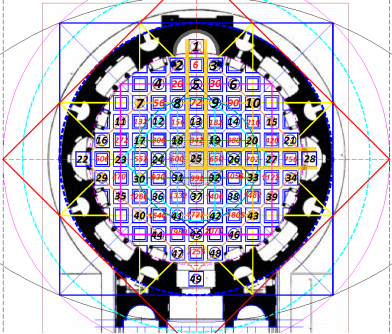
Figure 6. The identification of the 10+1 Tetraktyes, invisibly inscribed in the Pantheon inner floor plan.
Figure 7. A numerological analysis of the Rotunda floor plan, which follows the logic of the arrangement of the Tetraktyes.
The drawing of the 10 Tetraktyes, which are invisibly structured on the inner floor of the Pantheon, can be materialized with relative ease. As for the 11th Tetraktys, a four-part arrangement (shaded area around the center,
Figures 6 and 7) that develops crosswise towards the four cardinal directions E-W and N-S, it is included in the free circle h (red,
Figure 5) of the center of the floor (corresponding to the Oculus of the Dome) and belongs to the Unit / Monad (1), i.e. to Apollo – Helios
| [8] | Joost – Gaugier C. L, “Measuring Heaven: Pythagoras and His Influence on Thought and Art in Antiquity & Middle Ages”, Cornell University Press, 2006. |
| [3] | Cumont F., "Recherches sur le symbolisme funéraire des romains”, Paris, 1942-b. |
[8, 3]
, since the Supreme God of Antiquity was considered an omnidirectional Tetraktys in itself.
A version of the Pythagorean numerological analysis of the Rotunda floor follows the logic of the Tetraktyes invisibly structured in it:
The absolute center is occupied by the Pythagorean number 25, equivalent to (32+42) or to 52, that is, to the square of the hypotenuse of the ‘Sacred Right Triangle’.
Like the number 25 (52), the final number 49 (72) can also result from the development of the ‘quadratic’ series of numbers based on the unit / monad: 1, 22=4, 32=9, 42=16, 52=25, 62=36, 72=49 and so on.
In the context of this arrangement, a multitude of numerical relationships can be explored. For example, the circumference of the circle h (red,
Figure 5), i.e. the projection of the Oculus of the Dome on the floor, joins up four (4) numbers 18+19+31+32 with a sum of 100 (10x10). [When at some rare time, we estimate, the culminating Sun illuminated this point through the Oculus, the Roman priesthood considered it to be a happy and festive occasion, a ‘Theophany’, during which Apollo declared his active presence and his Universal reach].However, beyond its inherent numerical relationship, the theoretical projection of the Solar Oculus on the floor surface conceptually incorporates an obvious Cruciform arrangement, which consists of a circular slab in the center framed in the basic directions of East-West and North-South by four additional square slabs.
From the special relations of the ad Quadratum geometric sequence it follows that the circumferences of both the auxiliary circle k (black,
Figure 5) which is inscribed in Α
Δ3 3rd internal square (red) of the "Secondary geometric sequence", and the other auxiliary circle y (azure,
Figures 6, 7), which circumscribes the Octagon inscribed in Α
Δ3 square, both participate in determining the elements of the cycle Dο, the so-called "Celestial circle" (azure), as well as in the design of the monument's floor.
We observe, for example, the circumference of the circle y (azure) to join twelve numbers 8+9+14+20+33+38+42+41+36+30+17+12 with a sum of 300 (3x100),while the sums 13+37+24+26, 5+45+23+27 and 1+49+22+28 which correspond to vertices of interconnected Tetractyes and form successive squares, for another time each gives the number 100 (10x10)!
Similarly, the sums (13+25+37) + (24+25+26) of the two central transverse axes, as well as the sums (18+25+32) + (19+25+31) of the two corresponding diagonal axes, which as a whole form the Mesopotamian Eight-pointed Sumerogram Dingir that means God, give the number 150 (1.50x100)which is equal to the diameter of the sphere inscribed in the monument.
If we assume that the ‘circular floor slabs’ are numbered consecutively as 1, 2, 3, 4... and so on, in the order in which the elements of a Tetraktys are listed, then one of the arithmetical sequences that arise from the analysis of the above elements is the following as shown in
Table 1:Table 1.
Secondary arithmetic sequence 6, 20, 30, etc resulting from the multiplication of two consecutive numbers of the primary numbering of the circular slabs of the Pantheon floor, which fills the gaps in the square slabs (cf Figure 7, numbers in red). 2x3 = 6 & 1x2+2x2 | 11x12 = 132 & 90+10x2+11x2 | 16x17= 272 & 210+15x2+16x2 |
4x5 = 20 & 6+3x2+4x2 | 12x13 = 156 & 132+12x2 | 17x18 = 306 & 272+17x2 |
5x6 = 30 & 20+5x2 | 13x14 = 182 & 156+13x2 | 18x19 = 342 & 306+18x2 |
7x8 = 56 & 30+6x2+7x2 | 14x15 = 210 & 182+14x2 | 19x20 = 380 & 342+19x2 |
8x9 = 72 & 56+8x2 | | 20x21 = 420 & 380+20x2 etc |
9x10 = 90 & 72+9x2 | | |
which fills in the corresponding square floor slabs with new numerical coefficients, and therefore with new relationships.
An exemplary series of the so-called ‘triangular’ numbers of Nicomachus of Gerasa (supporting the fundamental importance of the number 3 - three) is: 1, 1+2=3, 1+2+3=6, 1+2+3+4=10, 1+2+3+4+5=15, 1+2+3+4+5+6=21, 1+2+3+4+5+6+7=28 and so on, which appears on the upper right diagonal side of the Pantheon floor, opposite the entrance. Of its numbers, 1, 6, 15, 28 and so on are considered ‘hexagonal’ too.
By analyzing and combining the structural elements of the Pantheon Dome with the overall numerical data of the Tetraktyes invisibly inscribed on its floor, the following important relationships emerge, based on the privileged number 28:
1x28=28 / is a number equal to the total number of the embossed coffers included in each one annulus of the Dome, but also equivalent to the days of a Lunar month (with one day difference). The annuluses were five - 5 and correspond to the five Celestial bodies of Venus, Mercury, Mars, Jupiter and Saturn, of the then known "Planetary System".
5x28=140 / is a number equal to the total number of embossed coffers of the Dome,
13x28=364 / is a number approximately equal to the Lunar year (~355 days) and equal to the Solar year (according to the Julian calendar, but with one day difference from the newer Gregorian one),
25x28=700 / is a number equivalent to 5x5x28 (or 5x140, 7x100, 105x6.666), that is (according to Aristotle, Anatolius and Plutarch) equivalent to the sophistry of the consummated "Sacred Marriage" between the five - 5 Celestial bodies (Venus, Mercury, Mars, Jupiter and Saturn) of the then known "Planetary system" and the Sun, as they appear with their twenty eight - 28 consecutive positions within the duration of a Lunar month in relation to the Earth, that is, to the earthly observers
| [8] | Joost – Gaugier C. L, “Measuring Heaven: Pythagoras and His Influence on Thought and Art in Antiquity & Middle Ages”, Cornell University Press, 2006. |
| [16] | Ps.- Iamblichus, “Theology of Arithmetic”, transl. by R. Waterfield, Kairos 1988. |
[8, 16]
. [As archaeological information reports that the coffers of the Dome had special bright decorations inlaid, we can again assume that the Roman priesthood of the Pantheon had the daily duty το create a map of the sky, a calendar, by noting the position of each planet to the appropriate coffer of each annulus, and thus, placing their positions in relation to the midheaven Sun which was represented by the Light entering through the "oculus"].
The dimension of the internal diameter D2 of the Pantheon Dome has already been calculated as being equal to 150 Rf or 44.55 m, which, between others, led to the dimensioning of the internal diameter of the Oculus equal to 1/5x150 or 30 Rf or 8.90 m. T.A. Marder and M. Wilson Jones (“From Antiquity to the Present”, 2015) seem to agree with the assumption of the diameter D2 by taking into account local measurements, while other researchers estimate this dimension to have been somewhat smaller. This discrepancy is probably due to the fact that marble linings in the internal perimeter, as well as other repair work were added to the original construction...
Considering these preconditions as constant, the volume of the cylinder that constitutes the base of the monument is calculated to be π(D2/2)3 or 3.14159x753 or 1.325.360 Rf3, and the volume of the Dome hemisphere, which is proportional to 2/3 or 0.666 of the volume of the said cylinder, is calculated to be equal to (2/3)π(D2/2)3 or 0,666x3,142x753 or 883.573 Rf3. Therefore, the total volume of the monument, which is (5/3)π(D2/2)3 or 2.208.933 Rf3, can also be derived from the relation (5/3)πx558x756, or, and, the relation ~(32/19)πx552x756. As for the latter relation, it is observed that the number 552 appears in the body of a respective Tetraktys of the floor and constitutes the product 23x24, while, the number 756 that also appears in the body of an inscribed Tetraktys, results from the sum 6+30+90+210+420 of its components.
Ad Quadratum Axial Traces in the Ideal Dimensioning of the Pantheon’s Longitudinal Section
Roman feet: 1 Rf = 0,297 m.
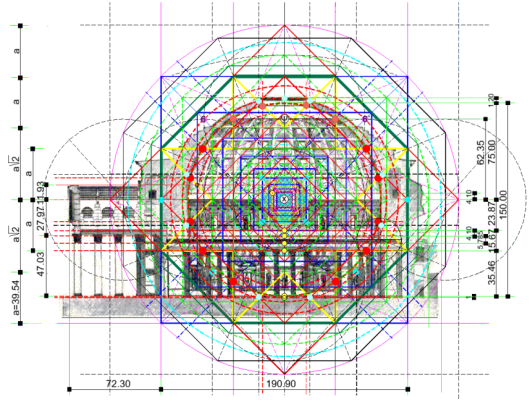
Figure 8. The ad Quadratum interpretation of the ideal dimensioning of the Pantheon's cross-section on the longitudinal axis.
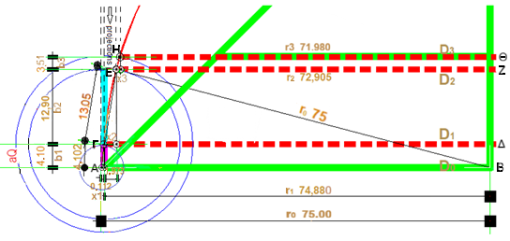
Figure 9. Details of the ad Quadratum interpretation of the ideal dimensioning of the Pantheon's cross-section on the longitudinal axis.
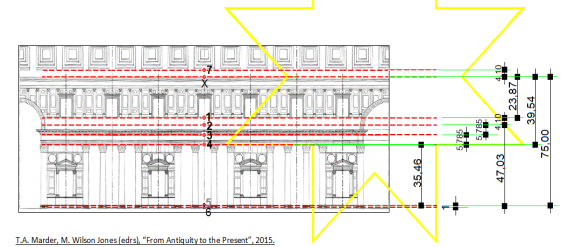
Figure 10. Expanded architectural drawing and dimensioning of the interior view of the ground floor and attic zone of the Pantheon's cross-section on the longitudinal axis. (The axes, the trace of the Eight-pointed star (yellow) and the dimensioning, is an addition made by D. Vil).
In the drawing of the Pantheon’s cross-section, its interior space is formed by the intersection of two geometric solids, a cylinder and a sphere inscribed in it with twice the height, [thus constituting the first “hyper-schematic / hyper-formative” typology in the History of Architecture and, consequently, the beginning of the abandonment of the prevailed for centuries 'standards' of its “Classical” sector, which gradually will be evolved in order to bring to the fore its “Romantic” sector during the Middle Ages].
Starting from the gallery / attic storey (
Figure 10) in the interior of the monument, 7x2=14 chapels / aediculae are located around the perimeter, which are framed by 2 columns each or a total of 28 columns.
Between them, 8x2=16 intermediate flat chapels / aediculae emerge (of which the 2+2 correspond to the width of the entrance niche and the niche opposite it). They are framed by 2 columns each or a total of 32 columns.
In the spaces between the flat chapels 16x2+2=34 panels are integrated, of which the mentioned 2 panels concern the keys of the entrance niche and the niche opposite it framed by 2x2=4 columns.
Therefore, the sum of the chapels / aediculae and integrated panels numbers a total of 14+16 +34 = 64 (4x6x2.666) elements, which are framed by 28+32+4 = 64 (4x6x2.666) columns.
If, however, we consider that of the 16 intermediate flat chapels / aediculae, the 2+2 of them (which belong to the width of the entrance niche and the niche opposite it) participate cumulatively in the conceptual design of the monument as a 1+1 elements, then the number of the active chapels / aediculae amounts to 14+14=28 elements corresponding to the number of coffers of each annulus of the Dome.
On the ground-floor perimeter of the Rotunda (
Figure 4), the 4 niches (including the entrance) which correspond to the basic cardinal directions of East-West and North-South – that is, to the ideal daily path of the Sun in the firmament – numbers a total of 4 columns and 8 pilasters, i.e. 12 structural elements.
In addition to the aforementioned elements, the trapezoidal 4 niches / aediculae, placed in the directions of the diagonals – which in the interpretive design of the monument are 'marked' in the recesses of the Eight-Pointed Star (yellow) of the ad Quadratum design infrastructure – numbers 8 columns and 8 pilasters or a total of 16 structural elements.
Given that beyond the above niches, the 8 chapels / aediculae projected in the inter-spaces – which in the interpretive design of the monument are ‘marked’ by the peaks of the Eight-Pointed Star (yellow) of the ad Quadratum design infrastructure – had a total of 16 columns, then, the resulting aggregate sum of the active aediculae (dedicated to the Zodiacal cycle) amounts to 4+8=12 (4x3 or 9/5x6.666), while, the sum of the 4 niches of the cross-shaped axes and their 12 structural elements added to the 16 +16 elements of the 12 aediculae, gives the number 60 (3x3x6,666).
The arrangement and the special decorations of the Dome coffers (which unfortunately did not survive) in relation both to the 28 perimeter chapels / aediculae of the attic storey and the conceptual arrangement of the statues of the 12 Zodiacal constellations – divinities in special places at the base of the cylindrical cella, but, additionally, to the well-shaped 8 niches arranged on the perimeter of the floor plan of the Temple (of which those on the rectangular axes meant the cross-shaped daily movement of the Solar disk, while the others on the diagonal axes meant its annual Solstices on an ideal flat map of the Heaven), constituted a brilliant conceptual whole, a visual Calendar that represented all the Celestial events known at that time, centered on the Great Bright Star that radiated a cycle of Light through the oculus of the Dome...
In the detailed drawing of the section (
Figures 9, 10), point X and the horizontal axis passing through it define the center and position of the diameter of the sphere which, with a dimension of 150 Rf, is inscribed in the interior of the Pantheon. They are consequently, the center and the position of application of the ad Quadratum geometric sequence both in the plan view and the section.
Point 1 is located through the distance (X-1), which is equal to the semi-diagonal of Α6 at an angle of 45° inner square of the ‘Primitive Geometric Sequence - PGS’ (red) with a side equal to A1/√2/√2/√2/√2/√2 = 33.745 Rf. Therefore, the distance (X-1) is equal to 23.87 Rf.
Point 2 is located through the distance (1-2), which results from the difference of the semi-diagonal of the above Α6 at an angle of 45° square, the side of which is equal to 33.745 Rf, from the semi-diagonal of ΑΔ5 at an angle of 45° inner square of the ‘Secondary geometric sequence’ - SGS’ (dashed green), the side of which is equal to ΑΔ1
Point 3 is located through the distance (2-3), which results from the difference of the semi-diagonal of A5 at an angle of 45° inner square of PGS (red), with a side equal to 47.73 Rf, from the semi-diagonal of AΔ5 at an angle of 45° inner square of SGS (dashed green), with a side equal to 39.535 Rf. Therefore, the distance (2-3) is equal to 33.75 - 27.96 = 5.785 Rf.
Point 4 is located through the distance (3-4), which results from the difference of the semi-diagonal of the above Α5 at an angle of 45° inner square of PGS, with a side equal to 47.73 Rf, from the semi-diagonal of ΑΔ4 at an angle of 45° inner square of SGS (dashed green), with a side equal to 55.91 Rf. Therefore, the distance (3-4) is equal to 39.535 - 33.75 = 5.785 Rf.
Point 5 is located through the distance (4-5), which results from the difference of the semi-diameter of the circle / cross-section of the sphere inscribed in the interior of the Pantheon, which is equal to 75 Rf, from the semi-diagonal of ΑΔ4 at an angle of 45° inner square of SGS (dashed green), with a side equal to 55.91 Rf. Therefore, the distance (4-5) is equal to 75.00 - 39.53 = 35.46 Rf.
Point 7 is used to estimate the vertical distance between the axis passing through it and the axis passing through point (X). The distance is obtained from the orthogonal relationships of both the inner square ΑΔ7 of the SGS (yellow) and the corresponding to it square, being at an angle of 45°. Given that their sides are equal to 19.77 Rf, the distance between the axis passing through x and 7 is calculated to be equal to 4.10 Rf.
The sum of the dimensions 23.87 +4.10 +5.785x2 +35.46 which appear in the ‘Detailed drawings of
Figures 8 and 10 is equal to 75 Rf, that is, equal to the semi-diameter of the sphere inscribed in the interior of the Pantheon. Furthermore, it follows that the height of the columns of the Pronaos is 35.46+2x5.785 = 47.03 Rf or 13.95 m., while the height of the Pediment is formed in a dimension of 4.10+23.87+11.93 = 39.90 Rf, and, by option in 40.00 Rf or 11.90 m (
Figure 8).
It is worth noting that the ratio between the radius of the sphere inscribed inside the monument, and the height of 23.87 Rf of the gallery / attic storey of the monument is equal to 75/23.87 = 3.142, that is, equal to the coefficient (π) in the geometry of the circle.
Furthermore, the ratio between the height of the ground floor zone of the monument (including the cornice attached to it), to the radius of the sphere inscribed inside the monument, is equal to 44.137/75 = 10/17
3. The Design of the Coffered Dome of the Pantheon: An Approach to Its Spherical Geometry
Figure 11. A detail of the ideal dimensioning of the first row of coffers of the Pantheon dome.
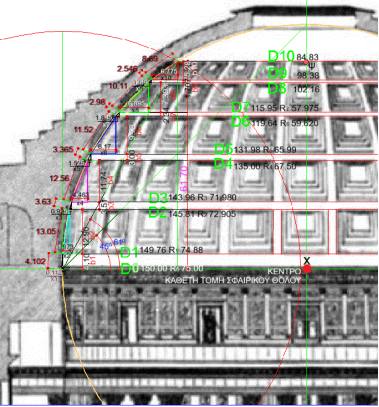
Figure 12. The ideal dimensioning of the coffered Dome of the Pantheon.
The way in which the pioneering hemispherical dome and its five (5) horizontal internal rows of a total of 140 almost square coffers were designed, and most importantly, were constructed, required, above all, the advanced static and geometric knowledge of an exceptionally trained architect and engineer, such was, for example, Apollodorus of Damascus at that time… The perfect construction of the cast hemispherical dome was made possible by both the multiple axial traces with built-in ratios of the ad Quadratum geometric sequence, on which the plan and section of the monument were prepared, and a process of geometrical determination of the dimensions and position of the square coffers on the hemispherical surface (as Menelaus of Alexandria
| [6] | D’ooge M.L., “Nicomachus of Gerasa. Introduction to Arithmetic”, Vol IX, MacMillan, New York, 1926
https://babel.hathitrust.org/cgi/pt?id=mdp.39015005675411;view=1up;seq=40 |
| [11] | Lindberg D.C., “The Beginnings of Western Science, The European Scientific Tradition in Philosophical, Religious, and Institutional Context, Prehistory to A.D. 1450”, University Of Chicago Press; 2nd edition, 1992 (2008). Ελλην. μεταφ. Πανεπ. Εκδ. Ε.Μ.Π. 1997. |
| [14] | Πινότσης Α.Δ., “Η εξέλιξη των κοσμολογικών ιδεών και των μαθηματικών μοντέλων στην Αρχαία Ελλάδα / The evolution of cosmological ideas and mathematical models in Ancient Greece”, Αθήνα, 2009. |
| [34] | Wikipedia: Μενέλαος ο Αλεξανδρεύς / Menelaus of Alexandria (in Greek).
https://el.wikipedia.org/wiki/%CE% (accessed January 2026). |
[6, 11, 14, 34]
had explained in his treatise "Spherica"). The specific calcu-lations at that time required, among other things, a good knowledge of extracting the roots of both rational numbers (written as fractions of whole numbers) and irrational num-bers (such as the coefficient π and the number √2), as well as the 'sines' of angles as ratios of sides in right triangles.
For the geometric design and subsequent construction of the coffers of the Dome, the horizontal axial trace - radius (AB) of the circle with diameter D
0, equal to 150 Rf (which results from the known vertical section of the sphere inscribed in the monument) is initially defined in the drawing - Section Detail (
Figures 11, 12). Successively, the horizontal axial trace - radius (ΓΔ) of the first circular base of the coffers, determined through the ad Quadratum geometric sequence from the height (aQ) or (X-7)=b
1=4.10 Rf, is also defined. From the data in question, the length of the radius (r
1) of the next circle D
102-4.10
22-4.10
2) =74.88 Rf, while the length X
1 = 0.112 Rf corresponds to the reduction of the radius (r
0) to obtain (r
1).
At this point, two critical assumptions are made for developing the calculations. The first concerns the perimeter of the circle D1, which is equal to 2πr1 or 470.49 Rf. It is divided into 28 equal parts of 16.803 Rf each one through the quadrupling of the geometric sequence of the Heptagon, which (as was mentioned in "introductory note II") results from the Triangular Geometric sequence. Each of the intervals that appear (which, we assume, were repeatedly tested in practice by the ancient technicians for their strength, by making scaled models of cementitious material) was chosen to be divided by a ratio of 1/3.50, or, more specifically, by one (1) part or 2.222/10 for the width of the transverse beam of each coffer, and by three and a half (3.5) parts or 7.777/10 for the width of the base and the side height of each coffer. If we assume, therefore, that 470.49 /28 = 16.80 Rf is the gross dimension at the base level of each coffer of the 1st row, then the width of each transverse beam is formed at 0.222x16.80 = 3.75 Rf or 1.11 m. and each coffer takes on its base and lateral side a dimension equal to 0.777/10x16.80 = 13.05 Rf or 3.875 m.
A second critical assumption is made for the development of the calculations: From the surrounding circle with radius 75 Rf and diameter 150 Rf in the vertical section, it follows that: since ¼ of the circumference of length (150x3.1415)/4 = 117.81 Rf corresponds to an angle of 90º, then in the circular sector (4.102+13.05) = 17.15 Rf an angle of (17.15x90)/117.81 = 13.10° will correspond. Therefore, the total height between point E and the axis AB is btotal = (sin13.10 x75) = 17.00 Rf, the height b2 is equal to 17.00 - 4.10 = 12.90 Rf, while from the formed right triangle it follows that the length X2 = 1.973 Rf.
In a process of shortening the calculations for the next rows of coffers, the study focuses on finding the dimensions of the lower base, the lateral side and the upper side of the coffers of every row, as well as on calculating the width of both the horizontal and transverse beams at the points of the planes that pass through the lower base and the upper side of the coffers. The entries of these calculations are as follows:
The diameter D2 is equal to D1–2xX2 = 149.76–2x1.973 = 145.81 Rf. Its circumference of 458 Rf is divided by 28 and the resulting interval 16.36 Rf corresponds to both the width of 12.725 Rf of the upper side of the 1st row of coffers, and the width of 3.635 Rf of the transverse beam, 'which simultaneously, is the width of the horizontal beam overlying the 1st row of coffers’. In the circular sector (17.15+3.635) =20.78 Rf, an angle of 15.87° corresponds. Therefore, btotal = (sin15.87x75) = 20.51 Rf, the height b3 is equal to 20.51–12.90–4.10 = 3.51 Rf and the length X3 = √(3.6352 – 3.512) = 0.925 Rf.
The diameter D3 is equal to D2–2xX3 = 145.81–2x0.925 = 143.96 Rf. Its circumference of 452.26 Rf is divided by 28 and the resulting interval 16.15 Rf corresponds to both the width of 12.56 Rf of the base and the lateral side of the 2nd row of coffers, and the width of 3.59 Rf of the transverse beam. In the circular sector (20.78+12,56) =33.34 Rf an angle of 25.47° corresponds. Therefore, btotal2 – 11.742) = 4.463 Rf.
The diameter D4 is equal to D3–2xX4 = 143.96–2x4.463 = 135.00 Rf. Its circumference of 424.22 Rf is divided by 28 and the interval 15.15 Rf corresponds to both the width of 11.785 Rf of the upper side of the 2nd row of coffers, and the width of 3.365 Rf of the transverse beam, 'which simultaneously, is the width of the horizontal beam overlying the 2nd row of coffers’. In the circular sector (33.34+3.365) =36.71 Rf, an angle of 28.04° corresponds. Therefore, btotal2 – 3.002) = 1.525 Rf.
The diameter D5 is equal to D4–2xX5 = 135.00–2x1.525 = 131.98 Rf. Its circumference of 414.63 Rf is divided by 28 and the interval 14.81 Rf corresponds to both the width of 11.52 Rf of the base and the lateral side of the 3rd row of coffers, and the width of 3.29 Rf of the transverse beam. In the circular sector (20.78+11.52)=48.23 Rf, an angle of 36.85° corresponds. Therefore, btotal2 – 9.732) = 6.17 Rf.
The diameter D6 is equal to D5–2xX6 = 131.98–2x6.17 = 119.64 Rf. Its circumference of 375.86 Rf is divided by 28 and the interval 13.42 Rf corresponds to both the width of 10.44 Rf of the upper side of the 3rd row of coffers, and the width of 2.98 Rf of the transverse beam, 'which simultaneously, is the width of the horizontal beam overlying the 3rd row of coffers’. In the circular sector (48.23+2.98)=51.21 Rf, an angle of 39.12° corresponds. Therefore, btotal2 – 2.342) = 1.845 Rf.
The diameter D7 is equal to D6–2xX7 = 119.64–2x1.845 = 115.95 Rf. Its circumference of 364.26 Rf is divided by 28 and the interval 13.00 Rf corresponds to both the width of 10.11 Rf of the base and the lateral side of the 4th row of coffers, and the width of 2.89 Rf of the transverse beam. In the circular sector (51.21+10.11) =61.32 Rf, an angle of 46.845° corresponds. Therefore, btotal2 – 7.3932) = 6.895 Rf.
The diameter D8 is equal to D7–2xX8 = 115.95–2x6.895 = 102.16 Rf. Its circumference of 320.945 Rf is divided by 28 and the interval 11.46 Rf corresponds to both the width of 8.914 Rf of the upper side of the 4th row of coffers, and the width of 2.546 Rf of the transverse beam, 'which simultaneously, is the width of the horizontal beam overlying the 4th row of coffers’. In the circular sector (51.21+2.546) =63.865 Rf, an angle of 48.79° corresponds. Therefore, btotal2 – 1.7072) = 1.89 Rf.
The diameter D9 is equal to D8–2xX9 = 102.16–2x1.89 = 98.38 Rf. Its circumference of 309.07 Rf is divided by 28 and the interval 11.04 Rf corresponds to both the width of 8.59 Rf of the base and the lateral side of the 5th row of coffers, and the width of 2.45 Rf of the transverse beam. In the circular sector (63.865+8.59) =72.455 Rf, an angle of 55.35° corresponds. Therefore, btotal2 – 5.282) = 6.775 Rf.
The diameter D10 is equal to D9–2xX10 = 98.38–2x6.775 = 84.83 Rf. Its circumference of 266.50 Rf is divided by 28 and the interval 9.52 Rf corresponds to both the width of 7.405 Rf of the upper side of the 5th row of coffers and the width of 2.115 Rf of the transverse beam.
It is observed that the transverse height b
total equal to 61.70 Rf, which results in detail from the dimensioning of the coffers of the Dome (
Figure 12), is slightly smaller (by 0.65 Rf or 0.20 m) than the ad Quadratum height (X-Ψ) equal to 62.35 Rf, which is measured between the plane (6-6΄) of the Section of the Pantheon, and the plane of the diameter of the circle D
0 that passes through point X:
More specifically, the calculation of the said height (X-Ψ) is based on the circumferences of three ad Quadratum circles drawn in a row (black dashed,
Figures 8, 9), the middle one of which has the point X (the center of the sequence) as its center, and its circumference passes through the centers of the two following ones. All three circles are inscribed in that Octagon, which in turn is inscribed in the outer circumference (magenta) of the ad Quadratum geometric sequence with diameter D=270 Rf.
Since the radius of the sphere inscribed inside the monument is 150/2 = 75 Rf, and the vertical distance between the plane passing through the point X of its horizontal diameter, and the plane passing through the upper edge of the 5th row of the coffers at point Ψ is calculated to be 62.36 Rf and in practice at 61.70 Rf, then the Ratios between them are 75/62.35 = 1.20 = 6/5 and 75/61.70 = 1.215 = 17/14.





 Share This Article
 Twitter
 Linked In
 Facebook
 Copy
Copy Download